
'I am hoping that now with the strategic status of our relationship, the Indian voice will get heard in Saudi Arabia,' says Ambassador B S Prakash.

In the atmosphere created by the reaction to the PNB fraud and RBI's resolution framework, "don't lend, don't resolve" is bound to become the bankers' new mantra, says T T Ram Mohan.

Besides the manufacturing industry, voices in favouring the need for protectionism have also been heard from local start-ups, which at times find it tough to compete with global players that entered India with deep pockets.

'This has been an ongoing process,' says Ambassador B S Prakash, India's former consul general in San Francisco, 'but I believe a Modi visit to the West Coast can be a force-multiplier.'

Will the next generation possess an even more internationalist outlook, and lose their Indian identities entirely? Will they continue to believe in a larger role for business in society and go beyond the boardroom to truly understand the Indian consumer, ask Geoffrey Jones & Vinay Sridhar of Harvard Business School.

The Congress president's election comes up early next year and party workers fear Sonia may pass on her mantle to Rahul. If that happens or if she continues to remain at the helm but Rahul calls the shots, there could be large scale desertions of workers and leaders worried about their future.

'I was a bit startled when our host spoke with such force and at such great length about Terrorism.' 'Where did that come from?' 'He kept insisting that it comes from across the border.' 'I could not remember who all are across India's borders and was looking puzzled, but Zuma who understood my predicament, whispered "Pakistan".'

Are we creeping back to controls on corporate decision making? Three moves over the past eight months reinforce this notion, says Kanika Datta.

While chits and the formal financial sector are not 'largely substitutable', users like the commitment to savings that these enforce and the flexibility in borrowing, reports N Sundaresha Subramanian from New Delhi.

Helen Brand offers a CA's view on protectionism, money laundering and how India's implementation of Ind-AS will make it more attractive to investors.

If you have answers to these, you need not worry about Britain's exit from the European Union, Raghuram Rajan's exit from the Reserve Bank of India or Narendra Modi's chances of re-election in 2019; your financial future will be safe, says P V Subramanyam

Upasna Pandey goes out on the streets to gauge the mood ahead of the polls

Meanwhile, key BJP ally skips event to mark first year of Yogi govt.

A glance back at some important events that occurred in 2018.

Here's everything you need to know about the Goods and Services Tax Bill.

Includes those dealing in high-value property and petrol pump owners

To say capital gains from stocks are effortless shows little understanding of the treacherous investing terrain, says Debashis Basu.
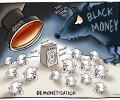
If currency controls are maintained indefinitely, popular support for Narendra Modi's demonetisation will turn into dislike, warns Devangshu Datta.

The most pressing issue facing the financial sector is the rising stock of non-performing assets in the banking system

'A class antagonism of rich versus poor took the colouring of a communal confrontation,' says Sunil Sethi.

The Budget may see new rural schemes and stepping up of funding towards existing programmes like MNREGA, rural housing, irrigation projects and crop insurance.

It is too late in the government's term for it to pull its usual trick of blaming the last guys.

A simple explainer to the Indus Water Treaty.

Kunnal Prem, chief executive officer of the Insurance Information Bureau of India, tells Mayank Jain on what they're doing.

Middle class constituted about 49 per cent of the total tax payees in financial year 2011-12

The cancellation of over a million duplicate or multiple permanent account numbers belonging to the same person or entity may have led to the disappearance of many of those who used to file returns earlier, but now no longer exist, says A K Bhattacharya.
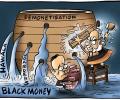
Assuming that demonetisation had not happened, the value of notes in circulation this year could have increased to Rs 19.3 lakh crore. But what we have, instead, by the end of August is a 20 per cent lower figure for currency notes in circulation, says A K Bhattacharya.
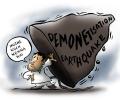
Utkarsh Mishra imagines what is it that Baba Gandhi would say if he got the chance.

'No finance minister has the capacity to put the economy in an ICCU just like no finance minister has the capacity to take it for 10% growth!'

If this Budget was not packaged and sold as a Budget for the poor and for farmers, Narendra Modi would have lost the next election.
A more vigilant Opposition and a more aware civil society including the media could have certainly helped keep a check on an unhealthy trend, says A K Bhattacharya.
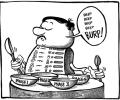
How sustainable and prudent is the policy of boosting services without commensurate growth in infrastructure in the relevant sectors, asksA K Bhattacharya.

As Rose Valley resurfaces, Sudip Bandyopadhyay and Tapas Pal's arrests marks the end of the bonhomie between the TMC and BJP.

With a staff crunch, it seems the I-T department would now target only the big fish rather than go after small assessees.

'Unless we change and we see a change in the direction we are taking, times can only get worse.'

GST, a much needed reform that widens the tax net, promises to strangle many legitimate businesses while they wait for the tax administration and systems to catch up, says Rahul Jacob.

'Physically, he is your boy next door, but attitude-wise, he is an evangelist who does not mind shouting from the rooftops to take a stand on a cause he believes in.'

We can hope that some of the benefits of the rural spending - on irrigation, roads, etc -- will spur rural demand and improve rural productivity, says P V Subramanyam.
We can hope that some of the benefits of the rural spending - on irrigation, roads, etc -- will spur rural demand and improve rural productivity, says P V Subramanyam.
We can hope that some of the benefits of the rural spending - on irrigation, roads, etc -- will spur rural demand and improve rural productivity, says P V Subramanyam.
 © 2026 Rediff.com - Advertise with us - Disclaimer - Privacy Policy - Sitemap - Feedback - About us - Terms of use - Grievances